


Many enterprise systems today are built on monolithic architectures—robust, reliable, and foundational to business operations.
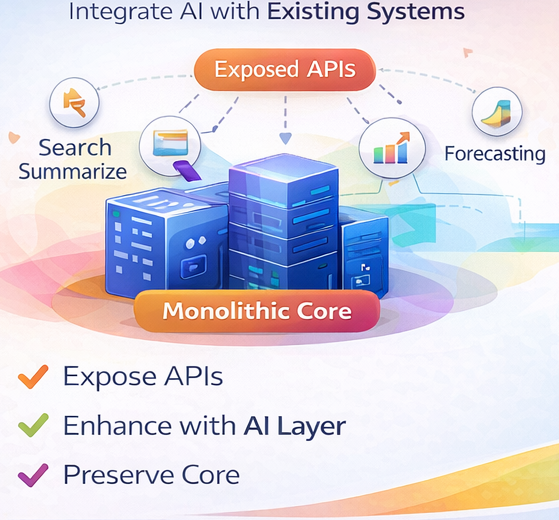
These tightly integrated designs have successfully supported core processes and long-standing business logic. In the AI era, the opportunity is not limited to replacing these systems, but to either extend them with intelligent capabilities or evolve them progressively toward more modular, AI-ready architectures.
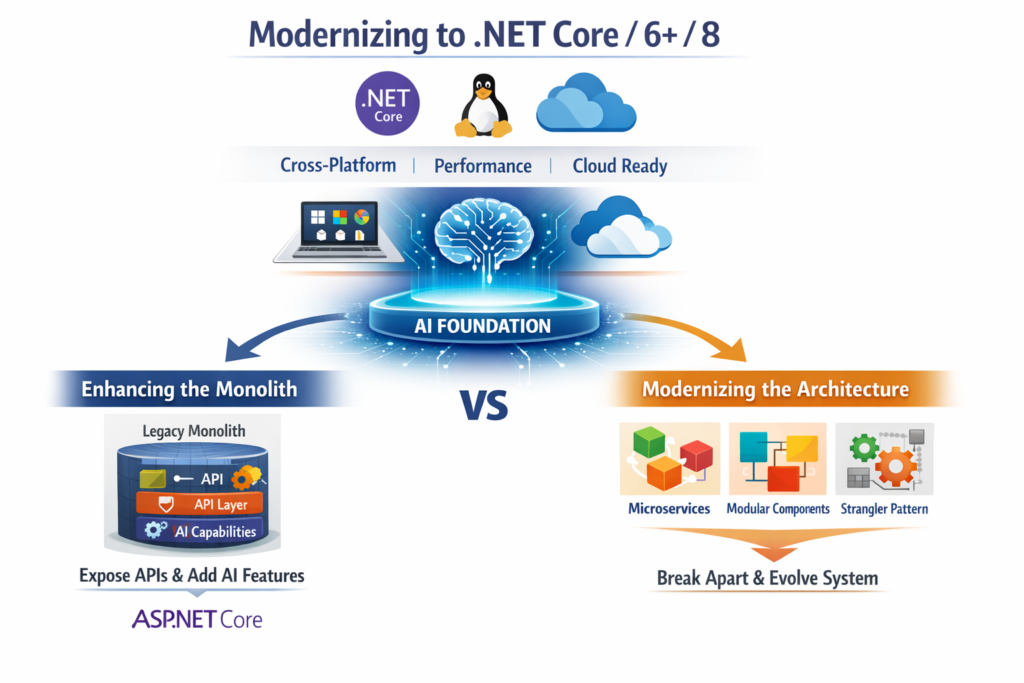
Modernization begins with transitioning to modern .NET (Core / 6+ / 8), enabling cross-platform support, improved performance, and cloud readiness. This creates a strong foundation for AI integration.
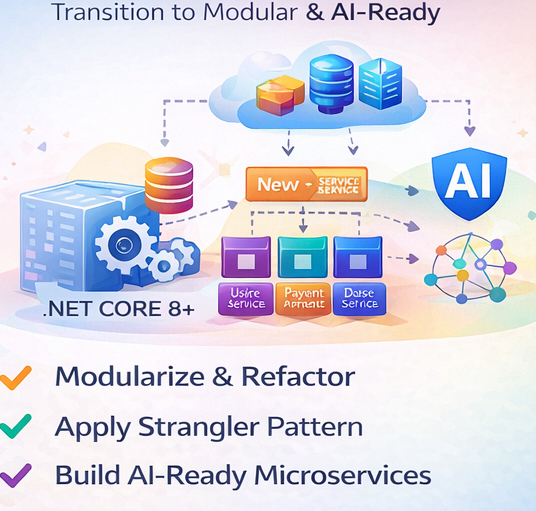
From here, organizations can choose their path. Some may continue working with the monolith by exposing APIs and layering AI capabilities on top, using frameworks like ASP.NET Core to enable seamless interaction. Others may begin restructuring—modularizing components, adopting microservices, or applying the strangler pattern to gradually replace parts of the system.

Cloud-native design further strengthens both approaches. Whether extending or evolving the monolith, leveraging containers, orchestration, and event-driven patterns enables scalability and resilience. These environments integrate naturally with services such as Azure OpenAI Service, allowing AI capabilities to be embedded into workflows without disrupting existing operations.
Equally critical is data readiness. AI success depends on clean, structured, and accessible data. Modernization must therefore include consolidating data sources and enabling real-time pipelines. Regardless of architecture choice, organizations can introduce AI incrementally as a capability layer—enhancing systems with predictive insights, intelligent recommendations, and automation using tools such as ML.NET.
Ultimately, modernization is both a technical and strategic decision. Some organizations will prioritize stability by extending their monoliths, while others will pursue agility through progressive decomposition or selective rebuilds.
The key is alignment with business goals. Rather than a one-size-fits-all solution, the objective is to transform existing platforms into AI-ready ecosystems—combining trusted foundations with intelligent, adaptive capabilities that drive future innovation.