



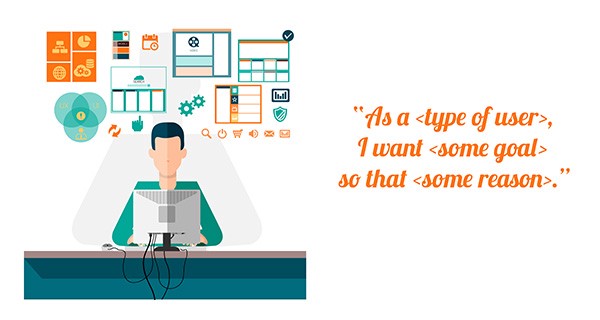
User stories are the essence of a sprint and are the fundamental building blocks that determines the deliverables and releases of a product.
A basic user story should consist of the following :
- Title
- Description
- Acceptance criteria
- Story points
- Scrum tasks
- Status

For example, the stories for a mobile calendar app to list all public holidays for a country should have clear stories with description such as below:
- As a user, I would like to see a list of all public holidays for my area in my country so that I can plan my holidays and work schedule accordingly.
In the acceptance criteria, it should provide the details of how this public holidays should be displayed.
- Given as a user, I would like to select a tab for either public or school holidays, then it will let me view the list of the corresponding holidays.
- Given as a user, I would like to select a country from a list, then it will display the corresponding holidays.
- Given as a user, I would like to select a filter for the holidays by national or state or region, then the list will be filtered according based on my selection.
- Given as a user, I would like to choose the month from a calendar which then lists the public holidays.
In the end, what constitutes a good story is the testability of the story from the Quality Assurance and user experience perspective.
The story need to address the needs of the business and ensuring that there are clear guides and boundaries when this story is tested.
One other detail that maybe good to have in the story is the technical description that may accompany the acceptance criteria which allows the technical team to understand what was built previously and can support and enhance in future.
In the end, user stories are the basic building blocks of a successful agile product. So, when it is created clearly that its description and acceptance criteria leaves no ambiguity, this results in a story that can be easily built by the developer and tested successfully by the tester.
The most satisfying aspect of it is the realization of this user story and the satisfaction after all the efforts has been completed and its finally out for users to enjoy and use.

Disclaimer: What I am sharing is purely from my point of view and does not reflect anyone else’s. What I present in my posts doesn’t necessarily mean tat it is applicable to your work, organization and culture. Would love to hear from you if you have any different opinions or feedback.